Hypertension Stage 3 (180/110 and Above): Act Now
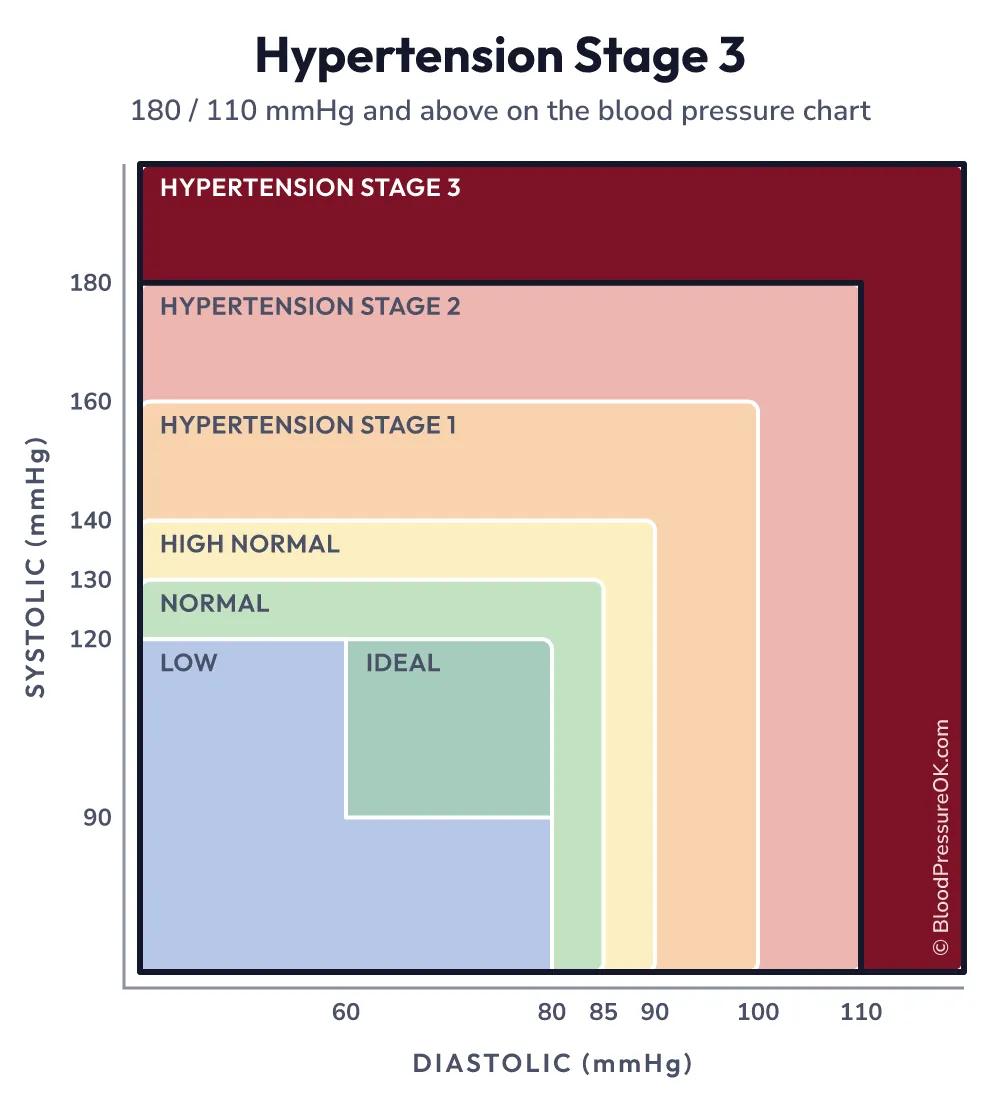
Hypertension stage 3 (grade 3) means a blood pressure of 180 systolic or more and/or 110 diastolic or more. This is the most severe category. It always needs prompt medical attention, and together with certain symptoms it is a medical emergency.
Call 911 (US) or your local emergency number now if a reading of 180/110 or higher comes with any of these:
- chest pain or pressure
- shortness of breath
- back pain
- numbness or weakness in the face, arm or leg
- vision changes
- difficulty speaking or understanding speech
Also call if you feel confused, very drowsy or have a sudden severe headache. Do not drive yourself to the hospital.
What this range means
A reading is grade 3 as soon as one value reaches the threshold: systolic 180 or more, or diastolic 110 or more. Examples are 185/115 and 190/100. In the US guideline (AHA/ACC), readings above 180 and/or above 120 count as severe hypertension; diastolic values of 110–120 count as stage 2 there.
Urgency or emergency?
| Hypertensive urgency | Hypertensive emergency | |
|---|---|---|
| Blood pressure | Very high (usually 180/110 or more) | Very high (usually 180/110 or more) |
| Symptoms of organ damage | None | Yes, such as chest pain, breathlessness, stroke signs, confusion |
| What to do | Contact your doctor the same day | Call 911 (US) or your local emergency number |
| Treatment | Oral medication, lowered over hours to days | Hospital, often intravenous medication under monitoring |
In a hypertensive emergency, the very high pressure is actively harming organs, for example causing a heart attack, stroke, heart failure with fluid in the lungs, a tear in the aorta or kidney damage. In pregnancy, severe high blood pressure can be a sign of preeclampsia and always needs immediate care.
If you get a very high reading without symptoms
- Sit down quietly for five minutes, then measure again with correct technique. Anxiety, pain or a cuff that is too small can push the reading up. See measuring blood pressure correctly.
- If it is still 180/110 or higher, contact your doctor the same day. If you cannot reach a doctor, go to an urgent care clinic.
- If any of the symptoms above appear, call 911 (US) or your local emergency number.
Do not take extra doses on your own
It may be tempting to take an extra tablet to bring the number down quickly. Do not do this unless your doctor has given you a written plan for exactly this situation. Lowering blood pressure too fast can reduce blood flow to the brain and heart and cause a stroke or heart attack. In a hypertensive urgency, doctors lower blood pressure gradually over hours to days. Do not stop or change your regular medication without medical advice either.
Common triggers
- Skipping or running out of blood pressure medication
- Painkillers such as ibuprofen or naproxen (NSAIDs), decongestant cold medicines, some herbal products and licorice
- Stimulant drugs such as cocaine or amphetamines
- Severe pain, heavy drinking or alcohol withdrawal
- Untreated or undiscovered hypertension, sometimes with a secondary cause such as kidney or hormone disease
What happens next
Most people with grade 3 hypertension need several medications, often started together as a combination pill. Your doctor will look for damage to the heart, kidneys, eyes and blood vessels, and for a secondary cause. See risk factors for high blood pressure. Once the acute phase is over, lifestyle changes help keep the numbers down. See 5 Quick and Easy Ways to Lower Your Blood Pressure.
Related: warning signs of hypertension, why does my chest hurt?, hypertension stage 2 (grade 2).
Reader questions
Selected from questions readers asked on this page, shortened and anonymized. Answers by the BloodPressureOK editorial team — general information, not a personal diagnosis.
My readings are around 185/115, but I feel completely fine. Is that an emergency?
Usually not an emergency in the medical sense, but it is not something to sit on for weeks either. Most people with stage 3 readings feel nothing, because high blood pressure rarely causes symptoms until it has done damage. Recheck after five minutes of quiet rest. If you are still at 180/110 or above, contact your doctor or an urgent care clinic the same day. It helps to bring your recent readings, a list of your medicines, and any recent changes such as missed doses, new painkillers, cold remedies or supplements. The doctor will usually check your urine, kidney blood tests, an ECG and sometimes your eyes for silent damage. Call 911 (US) or your local emergency number if chest pain, shortness of breath, back pain, numbness or weakness, vision or speech problems or confusion appear.
Why did the emergency room send me home when my reading was still above 170 or 180?
In most cases this is deliberate. The emergency team's job is to rule out a hypertensive emergency, meaning damage to the heart, brain, kidneys or eyes happening right now. If they find none, guidelines advise bringing very high pressure down gradually over hours to days with tablets, not to normal within an hour. Your brain and heart have adapted to the higher pressure, and a sudden drop can reduce their blood supply. So a reading still in the 170s at discharge can be part of the plan. What matters is what happens next. See your own doctor within days, ideally within a week, to start or adjust long-term treatment. Before you leave, ask when to follow up, which readings to aim for, and which symptoms mean you should come back.
I take three or four blood pressure medicines and still see readings over 180. What could be going on?
This is called resistant hypertension, and there is often a specific reason behind it. Start with the basics: check that your cuff is the right size and your technique is correct, and be honest about missed or irregular doses, which are very common. Then look for things that raise pressure: ibuprofen or naproxen, decongestants, steroids, some antidepressants, stimulants, licorice, alcohol and a salty diet. Untreated sleep apnea is a frequent hidden cause. Hormonal causes, especially primary aldosteronism (the adrenal glands making too much aldosterone), are much more common in resistant hypertension than many people realize, and so is kidney disease. Ask your doctor about screening or a referral to a hypertension specialist. Never change doses on your own, and treat any reading of 180/110 or more with warning symptoms as an emergency.
My upper number is not that high, but my lower number is 115 or more. Is that still stage 3?
Yes. One value is enough: a diastolic reading of 110 or more is stage 3 even when the systolic is only in the 130s or 140s, as in 146/117. In the US guideline, a diastolic over 120 counts as severe hypertension. A very high lower number is more typical of younger adults and can point to a kidney or hormonal cause, so it deserves a proper workup and same-day contact with a doctor. First rule out a measuring error, though. When the two numbers are unusually close together, for example 131/117, the cause is often a poorly fitting cuff, moving or talking during the measurement, or an irregular heartbeat. Repeat the measurement carefully before acting on it.
My upper number is over 180 but my lower number is normal, around 85. Is that dangerous?
Yes, it still counts as stage 3. A high upper number with a normal or low lower number is called isolated systolic hypertension. It is the most common pattern after about age 60, because large arteries stiffen with age. In older adults, the systolic value predicts stroke and heart disease better than the diastolic one, so a reading such as 190/85 should not be brushed aside. The same rules apply: recheck after rest, contact your doctor the same day if it stays at 180 or more, and call for emergency help if warning symptoms appear. Treatment works well even in people over 80 and clearly lowers the risk of stroke. Doctors usually lower the pressure step by step and watch for dizziness when standing up.
Can pain, stress or a panic attack push my blood pressure into stage 3?
Yes, temporarily. Severe pain after surgery or an injury, a migraine, a panic attack or intense anger can raise blood pressure by dozens of points, and it usually falls again as the trigger fades. Check again once you are calm. If the reading stays at 180/110 or higher, contact your doctor the same day whatever the cause. Pressure that jumps this high under stress often points to underlying hypertension that also needs treatment. Be careful with pain relief: anti-inflammatory painkillers such as ibuprofen and naproxen can raise blood pressure, so ask a pharmacist what suits you. One exception needs immediate help: a sudden, extremely severe headache, the worst you have ever had, may be a bleed in the brain rather than a result of stress. Call 911 (US) or your local emergency number.
I'm in my twenties and my readings are around 180/115. Why would someone so young have blood pressure this high?
Readings this high are unusual at a young age, so doctors look harder for a specific cause, known as secondary hypertension. Possibilities include kidney disease, hormone problems such as primary aldosteronism or thyroid disease, a narrowed kidney artery, a narrowing of the aorta present from birth, and sleep apnea. Substances matter too: energy drinks, decongestants, ADHD medicines, cocaine or amphetamines, anabolic steroids, some hormonal contraceptives and heavy drinking can all raise pressure. In muscular arms, a cuff that is too small gives falsely high readings. Family history plays a role as well, but it should not be the only explanation anyone accepts. Get seen promptly, and the same day if you are at 180/110 or more. Many secondary causes can be treated, and some can even be cured.
Are headaches, nosebleeds or dizziness signs that my pressure has reached stage 3?
Not reliably. Many people at stage 3 have no symptoms at all, while headaches and dizziness are very common in people with normal blood pressure. Nosebleeds are usually caused by dry or fragile vessels in the nose. Very high pressure can make a nosebleed harder to stop, but it is rarely the cause. So don't use how you feel to guess your blood pressure. Measure it. Some symptoms together with a very high reading are warning signs, though: a sudden severe headache, blurred or lost vision, confusion, chest pain, shortness of breath, or weakness or numbness on one side. Call 911 (US) or your local emergency number if these occur. A nosebleed that does not stop after 20 minutes of firm pressure also needs urgent care. See warning signs of hypertension.
I gave birth recently and my readings are over 160/110 with a headache. Is this serious?
Yes, take it seriously right away. Preeclampsia can develop after delivery, usually within the first week but up to about six weeks later, even in women whose blood pressure was normal during pregnancy. Readings of 160/110 or higher after giving birth count as severe and need emergency care now, especially with a headache that won't go away, vision changes, pain in the upper belly, shortness of breath or sudden swelling. Call 911 (US) or your local emergency number or go to the nearest emergency department, and tell the staff you recently had a baby. Readings of 140/90 or higher after delivery, even without symptoms, are a reason to contact your obstetric provider the same day. Postpartum preeclampsia responds well to treatment when it is caught early.
My home or pharmacy machine showed something like 230/200 or 300/25. Could the reading be wrong?
Possibly. A lower number almost as high as the upper one, an extremely wide gap or a pulse far above 150 are often measurement errors. Common causes are moving or talking, a cuff that is the wrong size or worn over clothing, an arm that is not supported, or an irregular heart rhythm such as atrial fibrillation, which confuses many automatic devices. Store machines with a one-size cuff can be off as well. Sit quietly for five minutes and repeat the measurement with a validated upper-arm monitor, trying the other arm too. Don't dismiss the result, though. If repeat readings stay at 180/110 or above, contact a doctor the same day. A very fast or irregular pulse with chest pain, faintness or breathlessness calls for 911 (US) or your local emergency number. See measuring blood pressure correctly.
How close to a stroke am I with readings over 200, and what happens if very high blood pressure is left untreated?
There is no single number at which a stroke happens. Risk climbs steadily with pressure: in large studies, the risk of dying from a stroke or heart disease roughly doubles with every 20 mmHg of systolic pressure above the normal range. Untreated stage 3 hypertension damages blood vessels, the heart, kidneys and eyes over months to years. In its most severe form, with bleeding or swelling in the back of the eye, it can cause organ failure within weeks to months. The encouraging side is just as clear: every 10 mmHg reduction in systolic pressure lowers stroke risk by roughly a quarter, and the benefit starts once treatment brings the numbers down. So the answer to a frightening reading is not to wait and watch. Get it treated and keep it controlled.
Is it safe to exercise with stage 3 readings, and is a reading like 185/115 right after exercise a problem?
If your resting pressure is 180/110 or higher, hold off on vigorous exercise and heavy lifting until it has been treated and your doctor agrees. Gentle walking is usually fine, but ask first. If you have just exercised, the reading tells you little about your resting pressure. Systolic pressure normally rises during exertion, so wait at least 30 minutes and rest for five before measuring. A diastolic value that climbs steeply with exercise is less typical, so mention it to your doctor. An exaggerated rise during exercise in someone with normal resting pressure can be an early sign of developing hypertension, so home readings are worth tracking. Once your pressure is under control, regular exercise is one of the best ways to keep it there. See sport and blood pressure.
Example readings in this category
- 136/110
- 139/110
- 142/110
- 145/110
- 148/110
- 151/110
- 154/110
- 157/110
- 160/110
- 163/110
- 166/110
- 169/110
- 172/110
- 175/110
- 178/112
- 181/114
- 184/116
- 187/118
- 190/120
- 193/122
- 196/124
- 199/126
- 202/128
- 205/130
- 208/132
- 211/132
- 214/134
- 217/138
- 220/140
Check a blood pressure reading
Related guides
- Ideal Blood Pressure (Below 120/80): What It Means
- Normal Blood Pressure (120–129 / 80–84)
- High Normal Blood Pressure (130–139 / 85–89)
- Hypertension Stage 1 (140–159 / 90–99): What to Do
- Hypertension Stage 2 (160–179 / 100–109)
- Low Blood Pressure (Hypotension): Below 90/60
- Measuring Blood Pressure Correctly: Step by Step
- 5 Quick and Easy Ways to Lower Your Blood Pressure
Sources: ESH 2023 guideline · AHA/ACC 2025 guideline · MedlinePlus: High blood pressure.
General information, not medical advice. Talk to your doctor before changing your diet, exercise or medication. A reading of 180/110 or higher with chest pain, shortness of breath, back pain, numbness or weakness, vision or speech problems, confusion or a severe headache is an emergency: call 911 (US) or your local emergency number.