How Does Alcohol Affect Blood Pressure?
Alcohol is one of the most common avoidable causes of high blood pressure. The more you drink, the higher your blood pressure tends to be, and cutting back lowers it within weeks. For people with hypertension, drinking less is one of the simplest and most effective lifestyle changes.
Short-term effects: down, then up
After drinking, blood pressure often falls slightly for a few hours because alcohol widens blood vessels. Studies show that after larger amounts it then rises again and can stay higher for the rest of the day and the following morning, together with a faster heart rate. This is one reason why readings after an evening of drinking can be confusing, and why you should not measure blood pressure shortly after drinking.
Long-term effects
Regular drinking raises blood pressure in a dose-dependent way: the more alcohol, the higher the readings and the greater the risk of developing hypertension. Recent analyses suggest that even about one drink a day is linked to a small rise in blood pressure, so there is no amount that is "good" for blood pressure.
The mechanisms include:
- activation of the sympathetic ("fight or flight") nervous system, which narrows blood vessels and speeds up the heart
- stimulation of hormones such as renin, angiotensin and cortisol that retain salt and water
- effects on the lining of blood vessels and on the body's blood pressure sensors (baroreceptors)
- extra calories that contribute to weight gain
Heavy drinking can also make high blood pressure hard to treat, and it weakens the heart muscle, raises the risk of atrial fibrillation and increases the risk of stroke.
How much does cutting back help?
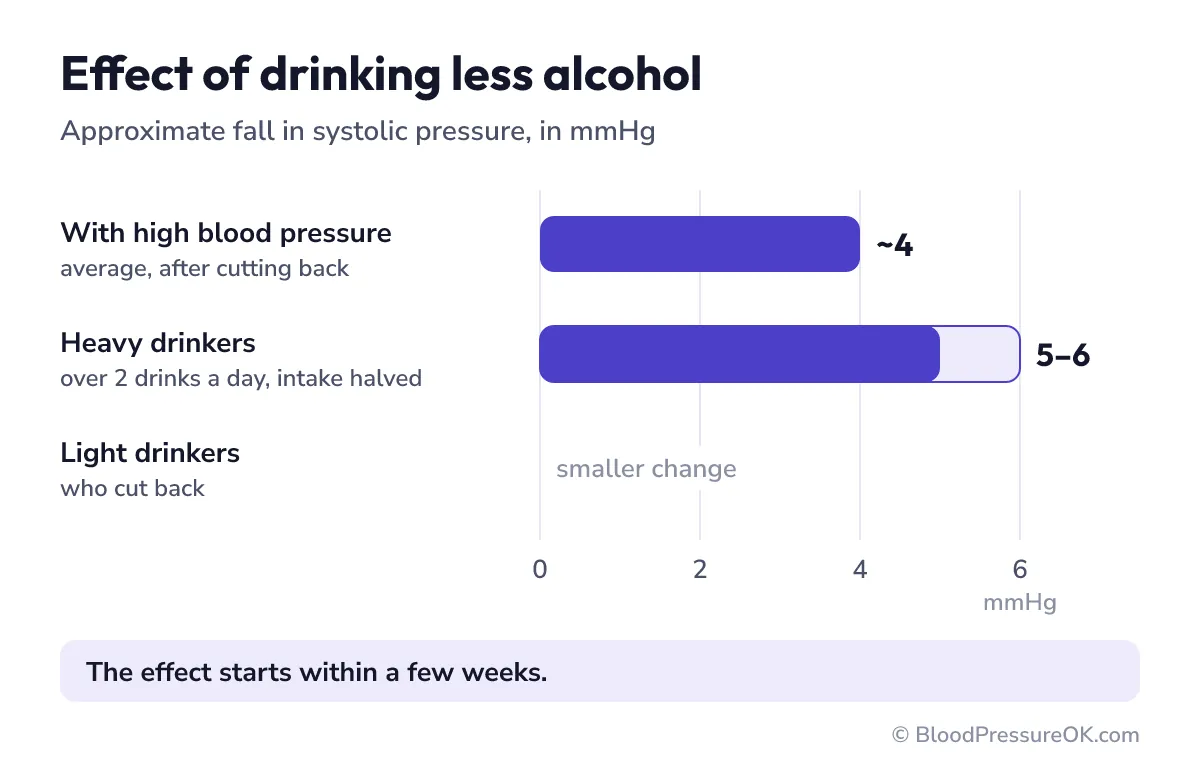
In people with high blood pressure, reducing alcohol lowers systolic pressure by about 4 mmHg on average. The effect is larger in heavy drinkers: in studies of people who had more than two drinks a day and cut their intake by about half, systolic pressure fell by about 5 to 6 mmHg. The effect starts within a few weeks. For people who drink little, the change is smaller.
What is "one drink"?
The size of a standard drink differs between countries. In the US, one drink contains about 14 g of pure alcohol; in the UK, a unit is 8 g; in many other countries a standard drink is about 10 g.
| Drink | Typical serving | Approx. alcohol |
|---|---|---|
| Beer (5%) | 12 oz / 355 ml | 14 g |
| Wine (12%) | 5 oz / 150 ml | 14 g |
| Spirits (40%) | 1.5 oz / 44 ml | 14 g |
Restaurant and home servings are often larger than these, especially for wine.
Recommended limits
- US guideline (ACC/AHA): people with high blood pressure who drink should limit themselves to no more than two drinks a day for men and one for women.
- European guideline (ESH 2023): less than 14 units a week for men and less than 8 units a week for women, and avoid binge drinking.
These are upper limits, not targets. For blood pressure, less is better, and not drinking at all is best.
Practical tips
- Plan several alcohol-free days each week.
- Avoid binge drinking: several drinks in one evening raise blood pressure more than the same amount spread out.
- Choose smaller glasses, lower-strength or alcohol-free beer and wine, and alternate alcoholic drinks with water.
- Be aware that alcohol can interact with blood pressure medicines and cause dizziness.
- If you drink heavily every day, do not stop suddenly without medical advice. Withdrawal can be dangerous and also raises blood pressure temporarily; your doctor can help you cut back safely.
See also: 5 Quick and Easy Ways to Lower Your Blood Pressure, risk factors for high blood pressure and hypertension stage 1 (grade 1).
Reader questions
Selected from questions readers asked on this page, shortened and anonymized. Answers by the BloodPressureOK editorial team — general information, not a personal diagnosis.
I'm older and active, drink three or four glasses of wine a day, and my reading is around 145/58. Would cutting back help?
Very likely. Three or four glasses of wine a day is well above the recommended limits, and in regular drinkers, cutting intake roughly in half lowered systolic pressure by about 5 to 6 mmHg in studies, within a few weeks. A reading like 145/58 is typical of isolated systolic hypertension, the most common form in older adults, so even a few mmHg matter. Being physically active is excellent, but it does not cancel out the effect of alcohol. Add plenty of water, especially around exercise, since alcohol and heavy sweating together can cause dizziness. Measure at home for a week before and after cutting back so you can see the effect, and share the results with your doctor.
I stopped drinking and smoking and my blood pressure fell a lot within a week. Is that real?
It can be. The effect of alcohol on blood pressure is reversible and starts to fade within days to weeks of stopping, and the larger the previous intake, the bigger the drop tends to be. Each cigarette also raises blood pressure for a short time, so stopping removes those repeated spikes. Some of a quick improvement can also come from measuring more carefully or feeling more relaxed, so keep taking home readings for a few weeks to see where your average settles. One caution: heavy daily drinkers can develop withdrawal symptoms when stopping suddenly, including a temporary rise in blood pressure, shaking and sweating. If that applies to you, ask your doctor for help. Quitting smoking also lowers your risk of heart attack and stroke substantially.
During exercise I had a sudden dizzy spell and couldn't coordinate my movements for about half an hour. Could my low blood pressure be the cause?
Possibly, but a temporary loss of coordination, balance, speech or vision can also be a transient ischemic attack (TIA), a warning sign of a stroke. It needs urgent medical assessment, ideally the same day, even if you now feel completely normal, because the risk of a full stroke is highest in the first days after a TIA. If symptoms come back or are still present, call 911 (US) or your local emergency number immediately. Low blood pressure from blood pressure medicine, dehydration, heat or alcohol can also cause dizziness during sport, but it usually causes light-headedness or fainting rather than lasting incoordination. Bring your recent readings and a list of all medicines to the assessment, and do not change the medication yourself.
Check a blood pressure reading
Related guides
- How Does Age Affect Blood Pressure?
- How Does Coffee Affect Blood Pressure?
- How Does Salt Affect Blood Pressure?
- How Does Smoking Affect Blood Pressure?
- How Does Exercise Affect Blood Pressure?
- Measuring Blood Pressure Correctly: Step by Step
- 5 Quick and Easy Ways to Lower Your Blood Pressure
Sources: ESH 2023 guideline · AHA/ACC 2025 guideline · WHO: Hypertension fact sheet.
General information, not medical advice. Talk to your doctor before changing your diet, exercise or medication. A reading of 180/110 or higher with chest pain, shortness of breath, back pain, numbness or weakness, vision or speech problems, confusion or a severe headache is an emergency: call 911 (US) or your local emergency number.