How Does Coffee Affect Blood Pressure?
Coffee raises blood pressure for a few hours after you drink it, mainly because of its caffeine. But for most regular coffee drinkers, the long-term effect is small, and moderate coffee drinking is not linked to a higher risk of developing hypertension. There are a few exceptions worth knowing about.
The short-term effect
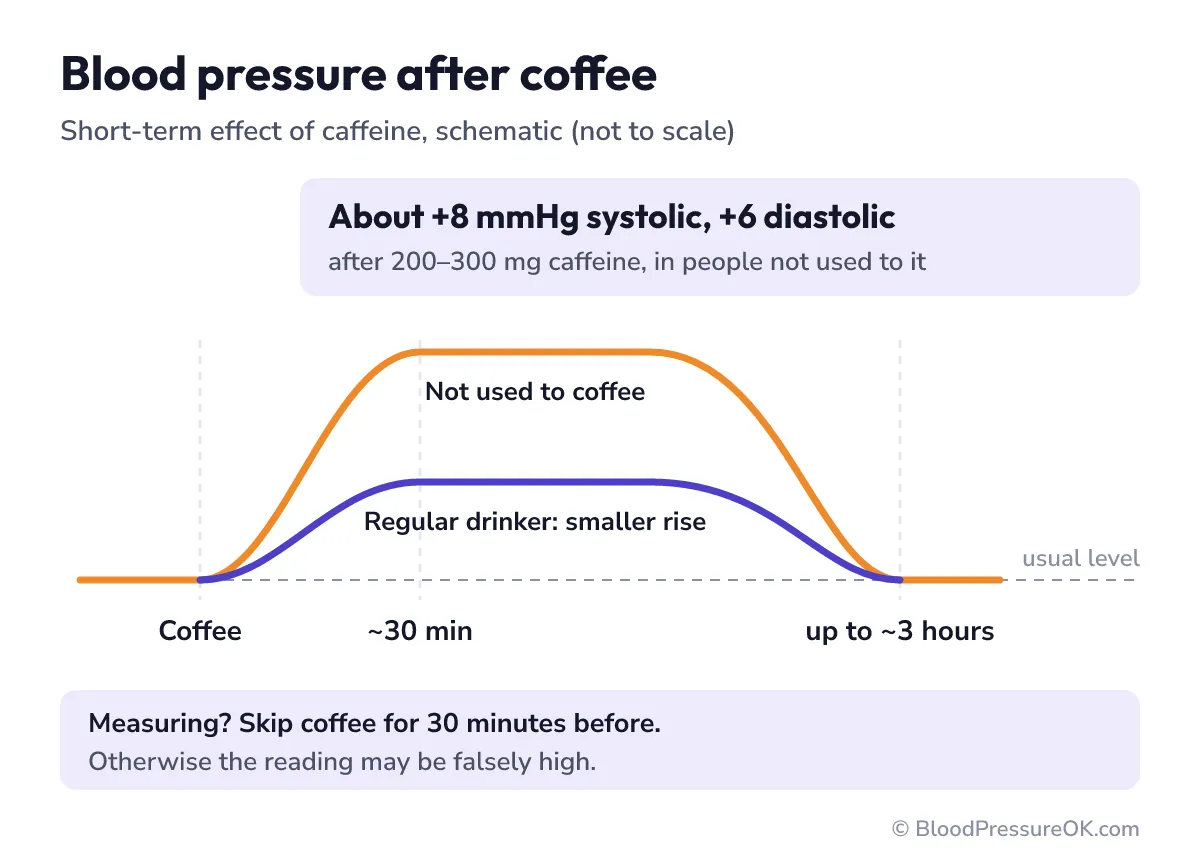
Caffeine blocks adenosine, a substance in the body that normally relaxes blood vessels, and it stimulates the release of adrenaline. As a result, blood pressure rises within about 30 minutes and stays raised for up to about three hours. In studies, 200 to 300 mg of caffeine (roughly two to three cups of brewed coffee) raised blood pressure by about 8 mmHg systolic and 6 mmHg diastolic in people who were not used to it.
In regular coffee drinkers, the body partly adapts. The rise becomes smaller, though in some people it does not disappear completely, especially after the first cup of the day.
The long-term picture
Large studies that followed hundreds of thousands of people for years have found that habitual, moderate coffee drinking (about three to four cups a day) is not associated with a higher risk of high blood pressure, and is linked to a neutral or slightly lower risk of heart disease. Coffee contains other substances, such as polyphenols, that may offset some of the effects of caffeine.
There are some caveats:
- Severe hypertension: a large Japanese study found that people with grade 2 or grade 3 hypertension who drank two or more cups of coffee a day had a higher risk of dying from heart disease. Green tea did not show this effect. If your blood pressure is very high, it is reasonable to limit coffee until it is under control.
- Sensitive individuals: people who rarely drink coffee, and some people who break down caffeine slowly, have stronger and longer-lasting rises.
- Unfiltered coffee (French press, boiled or Turkish coffee) raises LDL cholesterol, which matters for heart health even if blood pressure is unaffected.
Energy drinks are different
Energy drinks often combine large amounts of caffeine with sugar, taurine and other stimulants. In studies they raised blood pressure more than the same amount of caffeine alone, and some contain more caffeine per can than a strong coffee. Drinking several in a row, or mixing them with alcohol, has been linked to heart rhythm problems. People with high blood pressure or heart disease should avoid them.
How much caffeine is in what?
| Drink | Serving | Approx. caffeine |
|---|---|---|
| Brewed coffee | 8 oz / 240 ml | 80–120 mg |
| Espresso | 1 shot / 30 ml | about 60–75 mg |
| Black tea | 8 oz / 240 ml | 30–50 mg |
| Green tea | 8 oz / 240 ml | 20–40 mg |
| Cola | 12 oz / 355 ml | 30–40 mg |
| Energy drink | 1 can | 80–300 mg |
Health authorities consider up to about 400 mg of caffeine a day safe for most healthy adults, and up to 200 mg a day during pregnancy.
Coffee and measuring blood pressure
Because of the short-term effect, do not drink coffee, tea, cola or energy drinks in the 30 minutes before measuring your blood pressure; otherwise your reading may be falsely high. If you always drink coffee in the morning, measure before your first cup. See measuring blood pressure correctly.
Practical advice
- If your blood pressure is normal or well controlled, moderate coffee drinking is fine for most people.
- If you have grade 2 or 3 hypertension, consider limiting yourself to about one cup a day, or switching partly to decaf, until your blood pressure is controlled; discuss it with your doctor.
- Avoid energy drinks and caffeine pills.
- If coffee makes your heart race or keeps you awake, cut back; poor sleep also raises blood pressure.
See also: which tea lowers blood pressure? and 5 Quick and Easy Ways to Lower Your Blood Pressure.
Reader questions
Selected from questions readers asked on this page, shortened and anonymized. Answers by the BloodPressureOK editorial team — general information, not a personal diagnosis.
Can switching to decaf lower my blood pressure?
Possibly a little, but it is not a treatment. Decaf still contains a small amount of caffeine, usually around 2 to 15 mg per cup, compared with 80 to 120 mg in regular brewed coffee. In small studies, regular coffee drinkers who switched to decaf saw only modest drops in blood pressure, typically a few mmHg, and mainly those who are sensitive to caffeine or drink a lot of it. Decaf is a sensible option if coffee makes your heart race, disturbs your sleep, or if you have stage 2 or 3 hypertension and want to cut back on caffeine. Larger and more reliable effects come from eating less salt, drinking less alcohol, losing excess weight and regular exercise.
Are diet sodas harmful if I have high blood pressure?
They are not a major factor, but they are not a health drink either. Diet colas contain about 30 to 50 mg of caffeine per can, much less than coffee, and little sodium. Some large observational studies have linked frequent diet soda drinking with a higher risk of high blood pressure, but this may partly reflect that people who are already overweight or at risk tend to switch to diet drinks. Trials have not shown that sweeteners themselves raise blood pressure. Compared with sugary sodas, which are linked to weight gain and higher blood pressure, diet versions are the lesser problem. The best everyday choices are water, sparkling water and unsweetened tea or coffee in moderation.
My blood pressure is around 90/55. Can coffee help raise it?
Only briefly. Caffeine raises blood pressure for a few hours, especially in people who rarely drink coffee, but regular drinkers quickly build up tolerance, so it is not a reliable fix. If you feel well, a reading around 91/53 is often simply your normal and needs no treatment. If you feel dizzy, especially when standing up, drink enough fluids throughout the day, get up slowly and eat smaller meals. Some doctors suggest a cup of coffee with meals for people whose blood pressure drops after eating, but discuss this first. Persistent symptoms such as fainting, palpitations or exhaustion should be checked by a doctor. See low blood pressure.
My reading was 135/91. What should I do first?
Check whether the reading is real. A diastolic value of 91 is just in stage 1, but a single reading can easily be off by 10 mmHg. Coffee, tea, energy drinks or a cigarette in the previous 30 minutes, a full bladder, talking or rushing all push readings up. Measure at home for a week: two readings in the morning before your first coffee, and two in the evening, after sitting quietly for five minutes. If your average is 135/85 or more, see your doctor, who will also check for other risk factors. Meanwhile, the usual lifestyle steps apply. Moderate coffee drinking is generally fine, but cut back if you notice your readings are consistently higher after coffee.
Check a blood pressure reading
Related guides
- How Does Age Affect Blood Pressure?
- How Does Alcohol Affect Blood Pressure?
- How Does Salt Affect Blood Pressure?
- How Does Smoking Affect Blood Pressure?
- How Does Exercise Affect Blood Pressure?
- Measuring Blood Pressure Correctly: Step by Step
- 5 Quick and Easy Ways to Lower Your Blood Pressure
Sources: ESH 2023 guideline · AHA/ACC 2025 guideline · WHO: Hypertension fact sheet.
General information, not medical advice. Talk to your doctor before changing your diet, exercise or medication. A reading of 180/110 or higher with chest pain, shortness of breath, back pain, numbness or weakness, vision or speech problems, confusion or a severe headache is an emergency: call 911 (US) or your local emergency number.