Ideal Blood Pressure (Below 120/80): What It Means

A blood pressure below 120/80 mmHg is called optimal or ideal. It is the range with the lowest risk of heart attack, stroke, heart failure and kidney disease. If your readings are consistently in this range, there is nothing to treat; the goal is simply to keep it there.
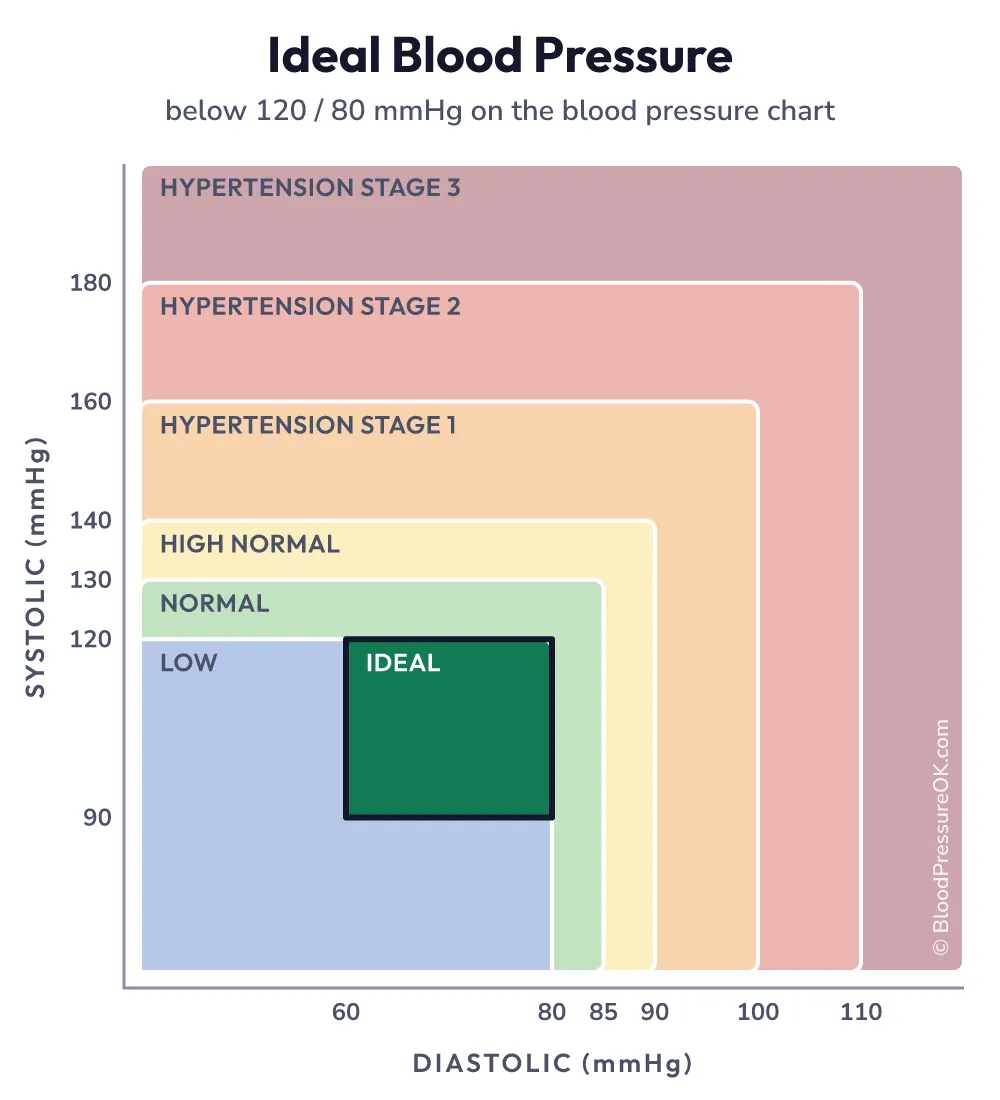
What "optimal" means
Blood pressure is written as two numbers. The first (systolic) is the pressure while the heart contracts; the second (diastolic) is the pressure while it relaxes between beats. For an optimal reading, both numbers must be in range: systolic below 120 and diastolic below 80. If only one number is higher, the higher category counts. So 115/75 is optimal, but 118/83 is "normal" because of the diastolic value.
A single reading says little. Blood pressure changes from minute to minute with movement, stress, coffee and even talking. What counts is the average of several readings taken at rest, ideally at home over several days. See how to measure correctly.
Why lower is better (up to a point)
Large studies that followed about a million adults show that the risk of dying from heart disease or stroke starts to rise from around 115/75. Among people aged 40 to 69, every 20 mmHg higher systolic (or 10 mmHg higher diastolic) pressure roughly doubles that risk. Someone with an optimal reading is therefore starting from the best possible position.
That does not make you immune. Blood pressure tends to rise with age as arteries stiffen, and most people develop high blood pressure at some point if they live long enough. An optimal reading today is a reason to keep healthy habits, not to stop checking. See how age affects blood pressure.
How the categories compare
| Reading | International (ESH 2023) | US (AHA/ACC 2017, confirmed 2025) |
|---|---|---|
| Below 120/80 | Optimal | Normal |
| 120–129 / 80–84 | Normal | Elevated (or stage 1 if diastolic 80–84) |
| 130–139 / 85–89 | High normal | Stage 1 hypertension |
Both systems agree: below 120/80 is the healthy target range. The US guideline simply calls it "normal" instead of "optimal".
Can it be too low?
For a healthy person there is no fixed lower limit. Many young, slim adults and endurance athletes have readings around 100/65 and feel perfectly well. A systolic value below 90 or a diastolic value below 60 is called hypotension, but it usually only matters if it causes symptoms, such as:
- dizziness or light-headedness, especially when standing up
- fainting or near-fainting
- blurred vision, unusual tiredness or difficulty concentrating
If you have such symptoms, or your blood pressure has dropped noticeably compared with your usual readings, talk to a doctor. Readings below 80 systolic or 50 diastolic need a re-check and, if confirmed, a doctor the same day; below 70 or 40, see how low is too low. If you take blood pressure medication and feel dizzy, do not simply stop it; ask your doctor whether the dose should be adjusted. More in low blood pressure (hypotension).
How to keep it optimal
The same habits that lower high blood pressure also help keep a good reading where it is:
- Watch the salt: most of it hides in bread, processed meat, cheese, ready meals and restaurant food. See salt and blood pressure.
- Eat plenty of vegetables, fruit, legumes and whole grains, in the style of the DASH or Mediterranean diet.
- Stay active: about 150 minutes of moderate activity a week, such as brisk walking or cycling.
- Keep a healthy weight, especially around the waist.
- Limit alcohol and do not smoke.
- Sleep enough and get snoring with breathing pauses checked, as sleep apnea raises blood pressure.
Have your blood pressure checked at least every few years, and every year once you are over 40 or have risk factors such as diabetes, excess weight or a family history of hypertension. For quick wins, see 5 Quick and Easy Ways to Lower Your Blood Pressure.
Reader questions
Selected from questions readers asked on this page, shortened and anonymized. Answers by the BloodPressureOK editorial team — general information, not a personal diagnosis.
How low can the bottom number be before it is a problem?
There is no single cut-off. A diastolic value in the 50s with a normal systolic value, such as 124/56, is common in older adults with stiffer arteries and in fit young people, and it is usually harmless if you feel well. Below 50 it is clearly low: measure again, and if it is confirmed or you feel dizzy, faint or confused, see a doctor the same day. It is also worth discussing with a doctor if the gap between the two numbers is very wide, if you have heart disease, or if you feel dizzy or faint. A noticeable drop when you stand up also matters: a fall of 10 mmHg or more in the diastolic value, or 20 mmHg or more in the systolic value, within three minutes of standing is called orthostatic hypotension and should be checked, particularly if it causes symptoms or falls.
My blood pressure is ideal but my pulse is in the 40s or 50s. Is that a concern?
Often not. A resting heart rate between 50 and 60 is common, particularly in people who exercise regularly, during sleep, and in people taking beta-blockers or some other heart medicines. Well-trained endurance athletes can have resting rates in the 40s. A slow pulse becomes a concern if it comes with dizziness, fainting, unusual tiredness, shortness of breath or reduced exercise capacity, or if it is below about 50 in someone who does not train much. In that case, see a doctor: an ECG and sometimes a longer heart rhythm recording can show whether the heart's electrical system is working properly. Note that a home monitor may miscount the pulse if the heartbeat is irregular.
At a checkup my reading was around 98/62 and the nurse rechecked it. Is that too low?
Not if you feel well. A reading like 98/62 is in the low-normal range and is typical for many young, slim and active people. Staff sometimes repeat a reading simply because it is lower than they usually see, or to make sure the device measured correctly, not because they suspect a problem. Low blood pressure matters when it causes symptoms such as dizziness when standing up, fainting, blurred vision or unusual tiredness, or when it is clearly lower than your usual readings. If none of these apply, there is nothing to treat. If you are unsure, ask at your next appointment whether the reading needs any follow-up; most doctors are happy to explain.
Is a reading with a small gap between the numbers, like 100/85, normal?
First, the category: because the higher category counts, 100/85 is high normal by its diastolic value, not ideal. A very small gap between the two numbers, called a narrow pulse pressure, is often a measurement artifact, for example from moving or talking, a poorly fitting cuff or an irregular heartbeat, so repeat the measurement after resting. If a gap of less than about a quarter of the systolic value shows up repeatedly, especially with tiredness, breathlessness or swelling, mention it to your doctor. In some people it reflects a reduced amount of blood pumped with each beat, which can have causes such as dehydration, blood loss or heart problems. In a healthy person with occasional readings like this, it rarely means anything.
My reading dropped after a glass of wine. Is alcohol good for blood pressure?
No. Alcohol widens blood vessels, so blood pressure often falls slightly for a few hours after a drink. After larger amounts it then rises again, together with a faster heart rate, and can stay higher into the next day. Over time, regular drinking raises blood pressure in a dose-dependent way, and recent studies suggest there is no amount of alcohol that benefits blood pressure. A single reading taken shortly after drinking therefore says nothing about the long-term effect. If you want to keep an ideal reading, drinking little or nothing is the safest choice. Do not measure within a few hours of drinking alcohol. More in alcohol and blood pressure.
My blood pressure is ideal now that I take medication. Can I stop it?
Not on your own. An ideal reading on treatment usually means the medicine is doing its job; blood pressure medicines work only while you take them, and readings typically return to their earlier level within days or weeks of stopping. Some drugs, such as beta-blockers, can also cause a rebound rise if stopped suddenly. If you have made big lifestyle changes, for example lost a lot of weight, cut down on alcohol and salt, or started exercising regularly, ask your doctor whether a lower dose is worth trying. This should be done step by step, with regular home readings and a clear plan for what to do if your blood pressure rises again. Many people stay on a low dose and simply keep their ideal reading.
My readings swing from ideal to high within hours. Which number is my real blood pressure?
Your real blood pressure is the average of readings taken correctly at rest over several days. Movement, stress, pain, coffee, a full bladder, talking and the time of day can change a single reading by 20 mmHg or more, so a value of 150 in the afternoon and 124 a few hours later is not unusual. Measure twice in the morning and twice in the evening for a week, sitting quietly for five minutes first, and average the results. Large swings with very high values are different: if a reading of 180/110 or more comes with blurred vision, severe headache, chest pain, shortness of breath, weakness or trouble speaking, call 911 (US) or your local emergency number. Without symptoms, contact your doctor the same day.
My blood pressure is ideal most of the time but rises when I'm anxious. Should I worry?
A rise during anxiety, panic or stress is a normal reaction: adrenaline speeds up the heart and narrows blood vessels, and readings such as 130/90 during an anxious moment are common. They usually fall again once the stress passes. What counts is your blood pressure at rest, measured when you are calm. Checking repeatedly when you feel anxious can create a loop, because worry about the number raises it further; set fixed times for measuring instead. Regular exercise, enough sleep and relaxation techniques help both anxiety and blood pressure. If anxiety or panic attacks are frequent, talk to your doctor, as effective treatment is available. Chest pain should never simply be put down to anxiety; get it checked.
Example readings in this category
Check a blood pressure reading
Related guides
- Normal Blood Pressure (120–129 / 80–84)
- High Normal Blood Pressure (130–139 / 85–89)
- Hypertension Stage 1 (140–159 / 90–99): What to Do
- Hypertension Stage 2 (160–179 / 100–109)
- Hypertension Stage 3 (180/110 and Above): Act Now
- Low Blood Pressure (Hypotension): Below 90/60
- Measuring Blood Pressure Correctly: Step by Step
- 5 Quick and Easy Ways to Lower Your Blood Pressure
Sources: ESH 2023 guideline · AHA/ACC 2025 guideline · MedlinePlus: High blood pressure.
General information, not medical advice. Talk to your doctor before changing your diet, exercise or medication. A reading of 180/110 or higher with chest pain, shortness of breath, back pain, numbness or weakness, vision or speech problems, confusion or a severe headache is an emergency: call 911 (US) or your local emergency number.