Measuring Blood Pressure Correctly: Step by Step
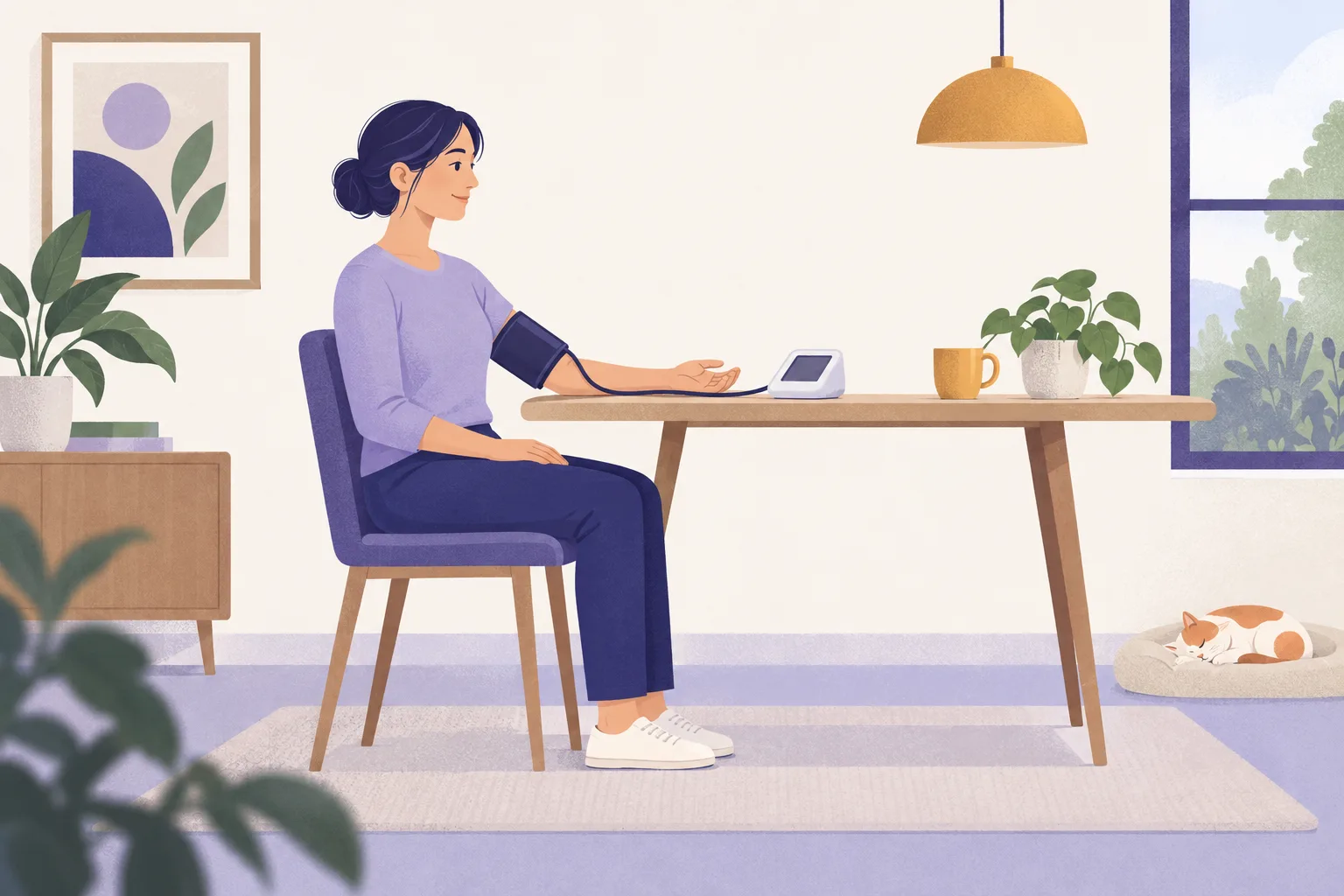
Small mistakes in how you measure can change a blood pressure reading by 10 mmHg or more, enough to move you into a different category. With the right device and a simple routine, home readings are very reliable, and often more useful to your doctor than a single reading at the office.
Choose the right monitor
- Upper-arm device: an automatic monitor with a cuff for the upper arm is the standard. Wrist devices are more error-prone because the wrist must be held exactly at heart level; finger devices and smartwatches are not accurate enough for diagnosis.
- Validated: choose a model that has been tested for accuracy. Lists of validated devices are available at validatebp.org (US), stridebp.org (international) and from the British and Irish Hypertension Society.
- Correct cuff size: measure around the middle of your upper arm and check it against the range printed on the cuff. A cuff that is too small gives falsely high readings; one that is too large, falsely low readings.
- Check it: take your monitor to your doctor's office once and compare it with their device.
Before you measure
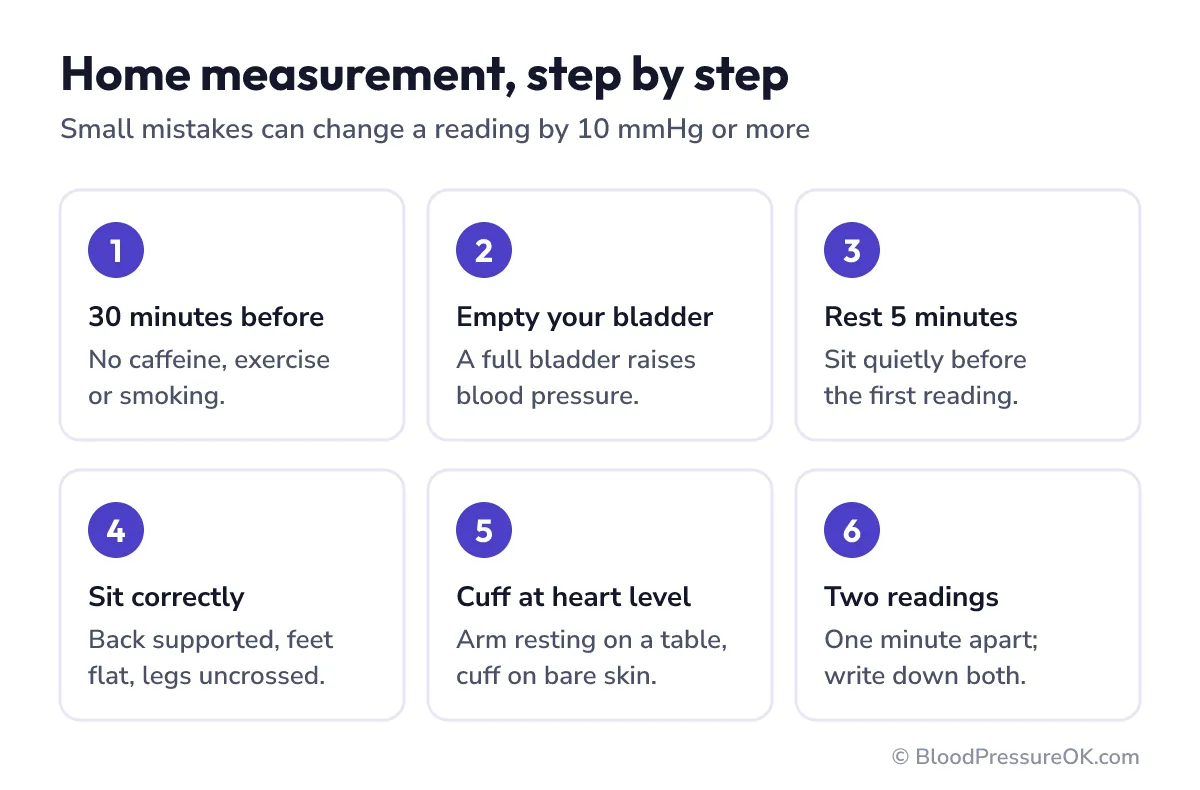
- No caffeine, exercise or smoking in the 30 minutes before.
- Empty your bladder; a full bladder raises blood pressure.
- Sit quietly for 5 minutes before the first reading.
Step by step
- Sit correctly: on a chair with your back supported, feet flat on the floor, legs uncrossed.
- Support your arm on a table so the cuff is at the level of your heart. A hanging arm gives readings that are too high.
- Put the cuff on bare skin, not over a sleeve, with the lower edge about 2–3 cm (1 inch) above the elbow crease. It should be snug, with room for about two fingertips underneath.
- Stay still and silent: no talking, phone or TV during the measurement.
- Take two readings, one minute apart, and write down both (or let the device store them).
Common mistakes
| Mistake | Effect on the reading |
|---|---|
| Cuff too small or over clothing | Too high |
| Arm unsupported or below heart level | Too high |
| Back unsupported, legs crossed | Too high |
| Talking during measurement | Too high |
| Full bladder, recent coffee, cigarette or exercise | Too high |
| No rest beforehand | Too high |
| Cuff too large | Too low |
When and how often
To get a reliable picture, for example before a doctor's visit or after a change in treatment:
- Morning: after using the bathroom, before breakfast, coffee and medication.
- Evening: before dinner or before bed.
- For 7 days (at least 3), two readings each time.
Your doctor will usually ignore the first day and average the rest. Once your blood pressure is stable, a few readings a week or a one-week series every few months is usually enough. Measuring many times a day can cause unnecessary worry.
The first time: both arms
When you first start, measure on both arms and use the arm with the higher reading from then on. A difference of more than about 10 mmHg between arms that shows up repeatedly should be mentioned to your doctor, as it can be a sign of narrowed arteries.
What do home readings mean?
Home readings are usually a little lower than office readings. A home average of 135/85 or higher is considered high by the European guideline; the US guideline uses 130/80. For the categories, see ideal blood pressure, high normal blood pressure and hypertension stage 1 (grade 1).
If you have an irregular heartbeat, such as atrial fibrillation, automatic devices may be less accurate; take three readings and ask your doctor about your device.
If you get a reading of 180/110 or higher, rest for five minutes and measure again. If it stays that high and you have chest pain, shortness of breath, back pain, numbness or weakness, vision or speech problems, confusion or a severe headache, call 911 (US) or your local emergency number. Without symptoms, contact your doctor the same day.
Related: coffee and blood pressure, hypertension stage 3 (grade 3).
Reader questions
Selected from questions readers asked on this page, shortened and anonymized. Answers by the BloodPressureOK editorial team — general information, not a personal diagnosis.
My readings are much higher at the doctor's office than at home. Which ones are right?
Both can be accurate; they just measure different situations. Many people have higher readings in a medical setting because of nerves, rushing and talking. This white-coat effect is common, and in a sizable share of people with high office readings, home readings turn out to be normal. The reverse, normal office readings but high values at home or during the day, is called masked hypertension. Doctors rely increasingly on home readings or a 24-hour monitor because they reflect everyday life better. To make your home readings convincing, use a validated upper-arm device, follow a fixed routine for a week and bring the stored values. Even with a pure white-coat effect, keep checking at home every few months, as it can turn into lasting hypertension over time.
Does it matter how I hold my arm with a wrist monitor?
Yes, a lot. A wrist monitor must be at the level of your heart. For every 4 inches (10 cm) the cuff is below heart level, the reading rises by roughly 7 to 8 mmHg, and it falls by the same amount if the cuff is above the heart. A wrist cuff on a hanging arm can therefore show a reading 20 mmHg or more too high. Sit with your back supported, rest your elbow on a table, and hold the wrist against your chest at heart level; some devices show a symbol when the position is right. Upper-arm monitors are less sensitive to this because the cuff is close to heart level anyway, as long as the arm rests on a table. That is one reason they are preferred for diagnosis.
My readings vary a lot from one measurement to the next. Which one counts?
None of them alone. Blood pressure changes from beat to beat, so differences of 5 to 10 mmHg between two readings a minute apart are normal, and the first reading is often the highest. Much larger jumps, such as from 169/70 to 114/44, usually point to a problem with the measurement: moving or talking, a cuff that is too loose or the wrong size, an arm that is not supported, or an irregular heartbeat. Always take at least two readings a minute apart and record both; if they differ by more than about 10 mmHg, take a third and use the average of the last two. Over a week, average all readings except those from the first day. If large swings persist with a careful technique, show your log to your doctor.
How can I check whether my blood pressure drops when I stand up?
Lie down quietly for about five minutes and take a reading, noting your pulse as well. Then stand up and measure again after one minute and after three minutes, keeping the arm supported at heart level. A fall of at least 20 mmHg in the systolic value or 10 mmHg in the diastolic value within three minutes is called orthostatic hypotension. If blood pressure stays stable but the pulse rises by 30 beats per minute or more within ten minutes of standing, together with symptoms, ask your doctor about postural orthostatic tachycardia syndrome (POTS). Have someone with you and a chair close by in case you feel faint, and sit down immediately if you do. Bring the results, including any symptoms, to your doctor.
I'm pregnant and my home reading was around 140/82. Is that a problem?
It needs prompt attention. In pregnancy, a systolic value of 140 or more or a diastolic value of 90 or more counts as high blood pressure. After 20 weeks, newly raised readings can be a sign of gestational hypertension or preeclampsia, which can become serious quickly for both mother and baby. Repeat the reading after resting for five minutes, sitting with your back supported and your arm at heart level. If it is still 140/90 or higher, contact your obstetric provider or maternity unit the same day. Call 911 (US) or your local emergency number if a reading is 160/110 or higher, or if you have a severe headache, vision changes, pain under the ribs on the right side, sudden swelling of the face or hands, or shortness of breath.
Check a blood pressure reading
Related guides
- Risk Factors for High Blood Pressure
- Low Blood Pressure — the Unknown Threat?
- 5 Quick and Easy Ways to Lower Your Blood Pressure
Sources: ESH 2023 guideline · AHA/ACC 2025 guideline · MedlinePlus: Blood pressure measurement · validatebp.org (validated monitors) · STRIDE BP (validated monitors).
General information, not medical advice. Talk to your doctor before changing your diet, exercise or medication. A reading of 180/110 or higher with chest pain, shortness of breath, back pain, numbness or weakness, vision or speech problems, confusion or a severe headache is an emergency: call 911 (US) or your local emergency number.