How Does Age Affect Blood Pressure?

Blood pressure changes over a lifetime. The systolic (upper) value tends to rise steadily from early adulthood into old age, while the diastolic (lower) value rises until about 50 to 60 and then slowly falls. These changes are common, but common does not mean harmless: high blood pressure at 75 carries the same kind of risk as at 45, and treating it still pays off.
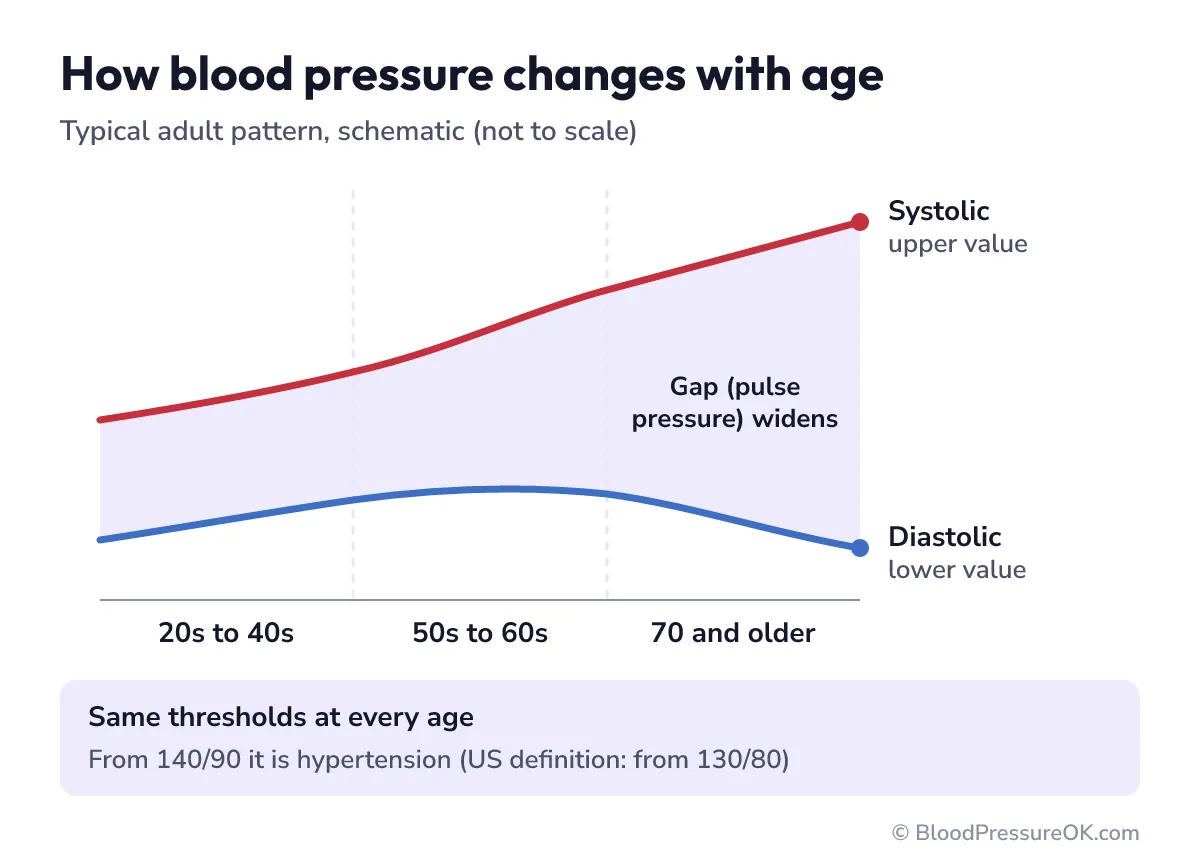
Why blood pressure rises with age
Large arteries such as the aorta work like elastic buffers. With each heartbeat they stretch and absorb part of the pressure wave, then recoil to keep blood flowing between beats. Over the decades, the elastic fibers in the artery wall wear out and are replaced by stiffer tissue, and calcium deposits build up. Stiffer arteries buffer less, so:
- systolic pressure rises, because the pressure peak is no longer cushioned;
- diastolic pressure falls, because the arteries recoil less between beats;
- the gap between the two (pulse pressure) widens.
Lifestyle adds to this. Salt intake, weight gain, inactivity and alcohol raise blood pressure over the years, and the kidneys become less efficient at removing sodium. In populations that eat very little salt and stay lean and active, blood pressure barely rises with age, which shows that the increase is not inevitable.
Typical patterns by age
| Age | Typical pattern | Most common type of high blood pressure |
|---|---|---|
| Children and teens | Lower values that rise with growth; judged by percentile charts for age, sex and height | Uncommon; often linked to overweight or another condition |
| 20s to 40s | Both values rise slowly | Raised diastolic value, often with overweight; more common in men |
| 50s to 60s | Systolic rises faster; diastolic levels off | Both values raised |
| 70 and older | Systolic keeps rising; diastolic falls | Isolated systolic hypertension |
Hypertension is very common in later life: most people over 65 have it. Women's blood pressure tends to rise faster after menopause, so by older age they catch up with men.
Isolated systolic hypertension
When the systolic value is 140 or more but the diastolic stays below 90, for example 160/78, doctors call it isolated systolic hypertension. It is the typical form in older adults and is a strong predictor of stroke and heart disease. A low diastolic value does not cancel out a high systolic one.
"Normal for your age" is a myth
An old rule of thumb said a normal systolic pressure is "100 plus your age". That would make 170 normal at 70. It is wrong. The same thresholds apply to adults of every age: from 140/90 it is hypertension by the international definition, from 130/80 by the US one. A reading of 150/85 at 75 is hypertension, not a normal sign of aging.
Trials in older people show clear benefits of treatment. In a large study of people aged 80 and over, lowering blood pressure reduced strokes, heart failure and deaths.
Targets for older adults
- Age 65 to 79 (European guideline): systolic target 130–139; lower if well tolerated.
- Age 80 and older: systolic target around 140–150, or 130–139 if well tolerated; caution with values below about 120.
- US guideline: below 130 systolic for healthy older adults living independently.
- Frail people or those with limited life expectancy get individual targets.
Older adults are more prone to dizziness when standing up, so doctors often measure blood pressure both sitting and standing. If you feel light-headed after starting treatment, tell your doctor rather than stopping the medication. See low blood pressure.
What you can do at any age
- Measure regularly; at least yearly from 40 onward. See measuring blood pressure correctly.
- Cut back on salt; older people are often more salt-sensitive. See salt and blood pressure.
- Stay active; walking, strength and balance training help blood pressure and prevent falls. See exercise and blood pressure.
- Review medicines that raise blood pressure, such as regular use of NSAID painkillers.
See also risk factors for high blood pressure.
Reader questions
Selected from questions readers asked on this page, shortened and anonymized. Answers by the BloodPressureOK editorial team — general information, not a personal diagnosis.
I'm over 65 and my bottom number is very low, like 155/50 or even 120/28. Is that dangerous?
A diastolic value in the 50s or 60s is common at this age because stiff arteries recoil less between beats. The wide gap between the two numbers (pulse pressure) is itself a marker of arterial stiffness and higher cardiovascular risk. A reading like 155/50 still counts as hypertension because of the systolic value. A diastolic value below about 40, as in 120/28, is very low. Measure again now, since it can be a measurement error. If it is confirmed and you feel faint, confused, short of breath, or cold and clammy, call 911 (US) or your local emergency number; otherwise contact your doctor today and ask whether an ultrasound of the heart is needed; a leaking aortic valve is one possible cause. When treating high systolic pressure in older people, doctors watch that the diastolic value does not fall too low, especially in those with heart disease.
I'm in my late 60s and my doctor called 130/60 perfect. Shouldn't it be below 120/80?
Your doctor is in line with current guidelines. For people aged 65 to 79, the European guideline aims for a systolic value of 130 to 139 on treatment, or lower if well tolerated, and the US guideline aims for below 130 in healthy older adults living independently. Below 120/80 is ideal as a starting point, but pushing blood pressure down hard in older age can cause dizziness and falls, so targets weigh benefit against side effects. A diastolic value of 60 at 130 systolic is common with age and not a concern if you feel well. What matters is that readings stay in the target range over time and that you have no symptoms when standing up.
I'm in my 20s and my readings are around 140/90. Can stress at work cause that?
Stress can raise blood pressure temporarily, and a single reading at a medical visit, perhaps with pain or nerves, can be misleadingly high. Long-term work stress, shift work and poor sleep are linked to modestly higher blood pressure. But stress is rarely the whole explanation, and high blood pressure in young adults is more common than many think, especially with excess weight, little exercise, a high-salt diet, alcohol, energy drinks or a family history. Measure at home for a week. If the average is 135/85 or more, see your doctor. In younger people, doctors also look for underlying causes such as kidney or hormone problems, and treating raised blood pressure early protects your heart and arteries for decades to come.
I'm over 70, very fit, and my readings have dropped to around 100/58. Is that too low at my age?
If you feel well, a reading like 102/58 is not dangerous in itself, and regular exercise does lower blood pressure. Older age does change the picture a little: the body adjusts to standing up more slowly, so dizziness and falls become more likely when blood pressure is low. Check your readings while sitting and again after standing for one and three minutes. See your doctor if your blood pressure has dropped noticeably compared with your usual values, if you feel light-headed, unsteady or unusually tired, or if you take blood pressure, heart, prostate or water pills, whose doses may need adjusting with age. Heat, illness and drinking too little can also lower blood pressure more in older people.
My teenager's readings are around 99/52. Is that normal at that age?
Usually, yes. Blood pressure in children and teenagers is lower than in adults and rises with growth until the late teens. Doctors judge it with percentile charts based on age, sex and height rather than adult categories; from about age 13, adult thresholds are used for high blood pressure. A slim, healthy teenager with a reading like 99/52 and no symptoms needs no treatment. Symptoms are a different matter: frequent nausea, paleness, dizziness, fainting, unusual tiredness or weight loss deserve a visit to the doctor, regardless of the reading, because they can have causes such as anemia, eating problems, digestive or hormone disorders that are worth finding.
Check a blood pressure reading
Related guides
- How Does Alcohol Affect Blood Pressure?
- How Does Coffee Affect Blood Pressure?
- How Does Salt Affect Blood Pressure?
- How Does Smoking Affect Blood Pressure?
- How Does Exercise Affect Blood Pressure?
- Measuring Blood Pressure Correctly: Step by Step
- 5 Quick and Easy Ways to Lower Your Blood Pressure
Sources: ESH 2023 guideline · AHA/ACC 2025 guideline · WHO: Hypertension fact sheet.
General information, not medical advice. Talk to your doctor before changing your diet, exercise or medication. A reading of 180/110 or higher with chest pain, shortness of breath, back pain, numbness or weakness, vision or speech problems, confusion or a severe headache is an emergency: call 911 (US) or your local emergency number.